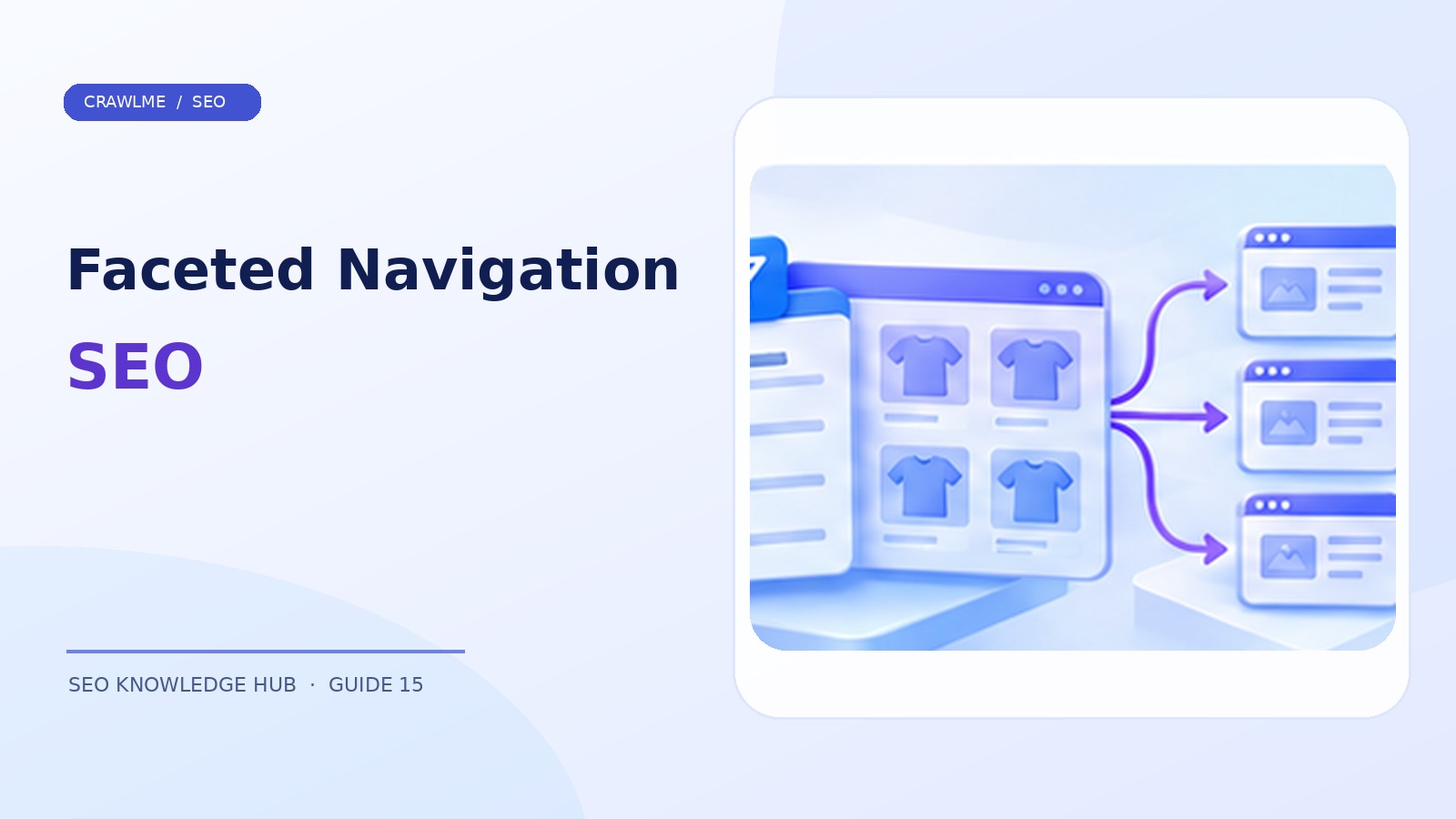
Faceted navigation lets shoppers narrow inventory by size, color, price, brand, or rating. It is excellent for shopping UX and potentially expensive for crawling: every combination may create a new URL, and recursive combinations can generate enormous spaces with little unique search value. The goal is not to remove useful filters. It is to keep the indexable URL set intentional and the crawler path manageable.
1. Map the parameter explosion#
Consider a category with 10 brands, 8 colors, 6 sizes, 5 price bands, and 4 sort orders. If the application allows arbitrary combinations, the theoretical state space becomes enormous. A crawler may encounter many URLs that display the same products reordered or only slightly filtered.
Begin by collecting the URL patterns from analytics, site crawls, internal links, and server logs. Group them by parameter: color=, size=, sort=, min_price=, page=, and session or tracking identifiers. Record which are intended landing pages and which exist only to support browsing.
2. Separate index-worthy facets from utility filters#
An indexed landing page should represent meaningful demand and distinctive content. A dedicated /running-shoes/womens/ page may deserve a stable URL, unique introductory content, internal links, and a self-canonical. A URL with ?sort=lowest_price generally represents the same merchandise reordered and rarely warrants a new indexable landing page. Real search demand, distinct inventory, and maintenance feasibility should guide the decision.
Create three categories:
- Indexable landing facets: Curated, unique pages intended for search discovery.
- Browsable but non-indexable utility states: Sorting, ephemeral combinations, and narrow temporary filters.
- Invalid or empty combinations: Impossible size/color combinations or filters returning no products.
Define expected HTTP status, canonical, robots behavior, internal links, and sitemap inclusion for each category.
3. Choose controls carefully#
Google's guidance on faceted navigation discusses preventing crawling of unnecessary parameter URLs, often using robots.txt where such URLs are not intended for crawling. This can be appropriate for large crawl traps, but do not blindly disallow entire directories containing valuable SEO landing pages. Remember that disallowed pages may still be discovered as URLs and that robots.txt is not a noindex equivalent.
Canonical tags can consolidate many near-duplicate accessible pages, but Google may still need to crawl those pages to encounter the signal. Thus canonicalization alone is not necessarily enough to control a truly infinite crawl space. Choose an approach that fits whether those URLs need to be accessible to search crawlers at all.
4. Keep filter URLs predictable#
Use stable parameter names and consistent ordering, rather than exposing both ?color=blue&size=m and ?size=m&color=blue as unrelated destinations. Avoid adding transient session IDs to crawlable links. Make URLs finite, reject unsupported parameter combinations, and return appropriate not-found statuses for invalid destinations instead of generating endless 200-status pages.
If filter combinations create meaningful content, build intentional static landing URLs rather than expecting millions of arbitrary query URLs to become useful search results.
5. Handle pagination and empty states#
Pagination URLs often represent distinct item sets, so evaluate them on their own merits rather than automatically canonicalizing every page to page one. Ensure products on deeper pages are discoverable through conventional links. For an empty filter state, show a helpful message to users, avoid creating misleading indexable pages, and select an HTTP status appropriate to whether the URL represents a valid but empty selection or a non-existent resource.
Don't redirect every invalid filter combination to the homepage: irrelevant redirects can be interpreted as soft 404s and are confusing for people.
6. Run a focused audit#
Select one major category and crawl it under controlled limits. Count unique URLs generated by each filter, depth from the category page, HTTP status distribution, canonical destinations, and pages linked by navigation. Then inspect server logs for repeated crawler requests to low-value patterns. A small sample can reveal an application-level combinatorial problem before it affects the whole catalogue.
A remediation sequence might be: stop generating infinite links; normalize parameter handling; create curated indexable category facets; update sitemaps; and monitor crawling of filter patterns over time.
7. Avoid SEO fixes that break commerce#
Filtering must remain usable for shoppers. Robots rules and canonicals apply to crawlers and indexing signals, not a requirement to delete application functionality. Coordinate changes between SEO, frontend, backend, and merchandising teams. Test saved filters, shareable URLs, product availability, analytics attribution, and mobile behavior before rolling out.
For enterprise sites, build a catalog policy document. Record which facets are allowed to generate crawlable landing pages, how much descriptive content is required, and who approves new indexable filters. Without a policy, every marketing campaign can introduce another uncontrolled parameter family.
Example: estimating unnecessary URL growth#
A store offers six sizes, eight colors, five brands, four price bands, and three sorting options for one category. If each combination gets a crawlable URL, the theoretical maximum is 2,880 combinations before pagination, session parameters, or duplicate parameter ordering. Multiply this by dozens of categories and the site quickly exposes a large set of URLs that shoppers may use but search engines do not need to index individually.
Rather than blocking all filters, identify a handful of genuinely valuable landing facets and build them deliberately. The remaining filter states can remain functional for users while the URL architecture and crawl-management controls limit unnecessary discovery.
Diagnose with a parameter inventory#
Export observed URLs and split query strings into parameter keys. Count unique values per key, common combinations, and how many URLs return the same canonical content. Then compare these patterns with server logs to see whether verified Googlebot requests are disproportionately concentrated on redundant variations. Be careful with logarithmic or sampled logs: they may not represent complete traffic. Use a representative measurement period.
Governance prevents the next crawl trap#
Require a review whenever developers introduce a new filter parameter or infinite-scroll behavior. Ask whether it creates new crawlable links, whether combinations have limits, how invalid states respond, and whether indexable landing pages should be curated separately. A small architecture policy is much cheaper than cleaning up millions of low-value URLs after they have been discovered.
Where CrawlMe fits#
Before sending a large product URL batch to CrawlMe, filter out transient sort combinations, duplicate parameter variants, and non-indexable states. A cleaner submission inventory saves operational effort, but Google still decides which URLs belong in its index.
Faceted-navigation checklist#
- Crawlable URL space is finite.
- Valuable facets have unique, stable landing pages.
- Sorting and tracking URLs are not treated as SEO targets.
- Robots and canonical controls reflect a clear policy.
- Invalid parameter combinations do not create endless 200 pages.
- Server logs and Search Console are reviewed after deployment.
Frequently asked questions#
Should all filter URLs be noindexed?#
Not necessarily. Some carefully curated facets have meaningful search demand; utility combinations generally do not need indexing.
Does canonical fix crawl traps?#
Not by itself. Crawlers may still need to fetch duplicate URLs to see canonicals, so infinite URL spaces need architectural controls.
Can I block all query strings in robots.txt?#
That is risky: some useful content may use query strings. Audit the parameter patterns before creating rules.