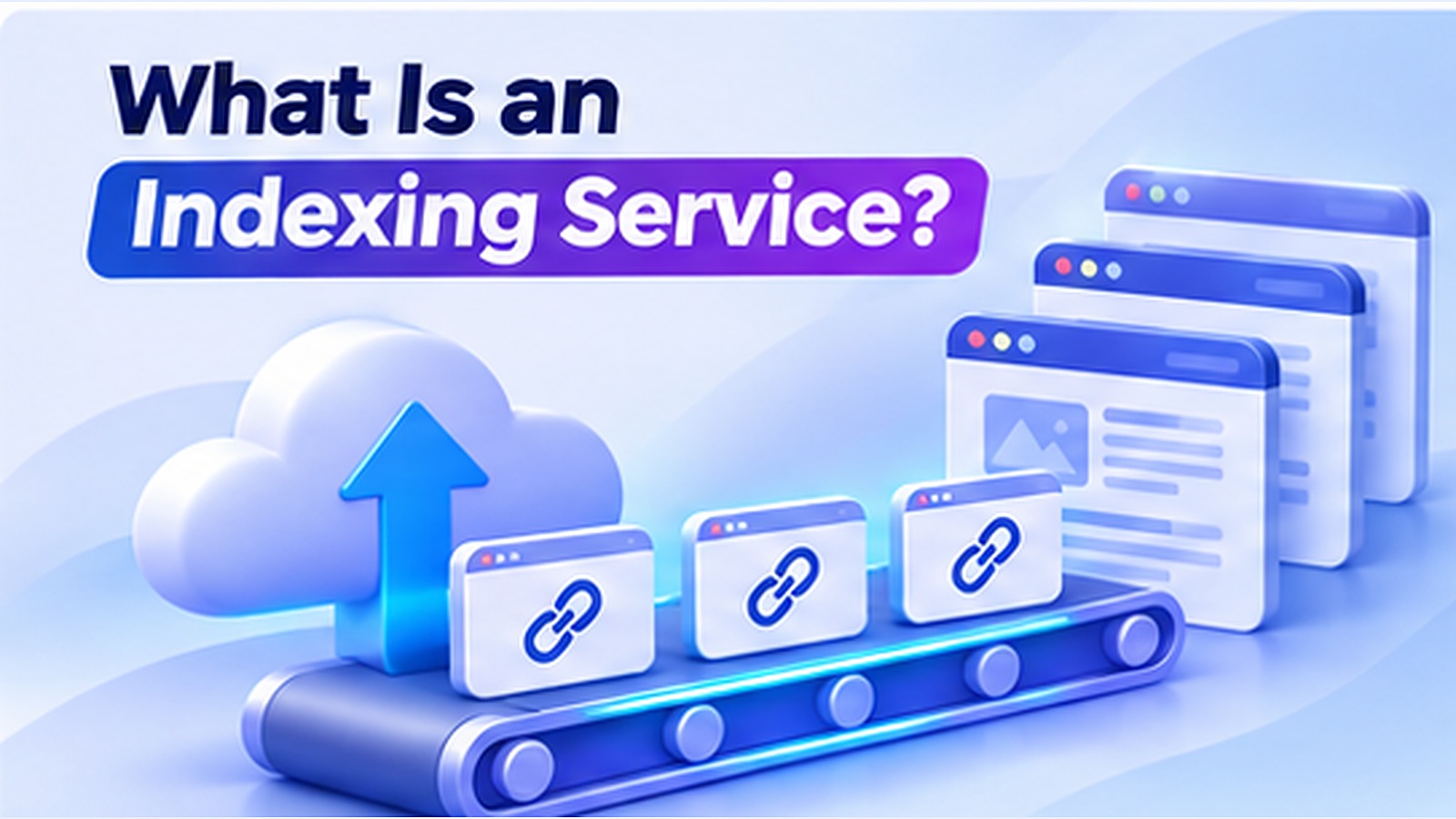
An SEO indexing service is a tool or service marketed to help search engines discover, revisit, or process URLs. Depending on the provider, it may offer a submission interface, an API, batch management, provider-based workflows, progress tracking, or other distribution methods. These offerings are not equivalent to having administrative access to Google's search index.
The most important principle is simple: submitting a URL and getting that URL indexed are different events. A service may confirm that it accepted or processed a URL without being able to prove Google indexed it.
The three things an indexing service might mean#
1. URL submission and workflow management. The platform accepts URL lists, validates inputs, creates jobs, and reports processing states. This is operational software; the benefit is less manual coordination.
2. Discovery assistance. Some services describe mechanisms intended to make URLs easier for crawlers to find or revisit. The quality, legitimacy, and effectiveness of methods vary. Ask providers to explain their practices rather than assuming every approach is official or effective.
3. Index-status monitoring. A different class of product attempts to determine whether a URL appears in Google's index. Verification methods have limitations, especially on third-party properties. An index-checking feature should disclose how it derives results and how often it refreshes them.
A single vendor may combine these functions, but a dashboard's green success state may refer only to task processing—not an independently verified Google result.
How Google's official discovery and indexing process works#
Google discovers URLs through links, sitemaps, and other sources. It crawls accessible pages, processes content and signals, and selects pages for indexing. Google may choose not to crawl or index every discovered URL. Pages that meet Google's minimum technical requirements are eligible, not guaranteed, to appear in Search.
For URLs you own, Google Search Console provides URL Inspection and sitemap submission. Google's official Indexing API has limited eligibility: it applies to pages with JobPosting or BroadcastEvent embedded in VideoObject markup, not ordinary articles or arbitrary backlink source pages. Any provider suggesting that the official API offers unlimited general indexing is making a claim inconsistent with Google's published eligibility rules.
What happens when you submit a batch?#
A typical submission-oriented platform follows a sequence such as:
- Input: You paste or upload a list of URL strings.
- Validation: The platform checks format, duplicates, and perhaps supported protocols.
- Queueing: Each accepted URL is associated with a job or batch.
- Processing: The service carries out its configured submission or distribution workflow.
- Result reporting: It updates records such as pending, processing, completed, or failed.
Each step is useful for operations, but the meaning of “completed” depends on the vendor's documented definition. A processed URL is not necessarily crawled; a crawled URL is not necessarily indexed; and an indexed page is not guaranteed to rank for any particular query.
When might a service be useful?#
SEO agencies: Campaign managers may need one place to coordinate large URL lists, remove duplicates, and maintain a submission history across clients.
Publishers: Teams launching many public pages may want an API-based handoff from their content workflow after publication checks have passed.
Backlink teams: A link-building operation may need a record of which source URLs were submitted while independently tracking whether the links are live and whether the publisher's pages are indexed.
Developers: Automation can reduce repetitive copy-paste work, particularly when batches are triggered by a content management system or an internal dashboard.
These are workflow benefits. They should be measured separately from search-result outcomes.
What an indexing service cannot legitimately promise#
No third-party provider can override Google's editorial and algorithmic indexing decisions. A service cannot fix a publisher's noindex directive or inaccessible server merely by submitting the address. It cannot guarantee a page's ranking, link equity, search traffic, or date of inclusion.
Be skeptical of universal guarantees, especially those that do not define “indexed” or show their verification method. Be wary of techniques that depend on fabricated signals, spam networks, or misuse of restricted APIs.
Checklist: choosing a provider#
| Question | Why it matters |
|---|---|
| What precisely counts as a completed submission? | Prevents confusing processing with indexing |
| Are results verified independently? | Clarifies the evidence behind claims |
| Are the methods documented at a practical level? | Helps assess risk and credibility |
| Is there a clear refund or failure policy? | Makes costs predictable |
| Can I export batch history? | Preserves records for clients |
| Does the API support authentication and sensible rate limits? | Helps operational reliability |
| Are URLs and client data handled appropriately? | Avoids leaking nonpublic campaigns |
| Can the service explain prohibited or unsupported use cases? | Tests honesty about limitations |
Consider trying a small, representative sample first. Include a mix of new pages, older public pages, and previously excluded URLs, but do not interpret the resulting changes as caused by the vendor without a sound comparison methodology.
Technical SEO still comes first#
Before paying for or automating submissions, confirm that the page is meant to be indexed. Check its HTTP response, robots directives, canonical target, internal links, and content usefulness. A page that returns a 404 or is intentionally noindex is not made suitable by resubmission.
A small editorial site may not need an indexing service at all. Search Console, a maintained sitemap, and good internal links may be enough. For a larger team, the administrative convenience may become more relevant.
How CrawlMe fits this category#
CrawlMe provides a credit-based URL submission platform, including bulk submission and API-oriented workflows. It can help users coordinate URL lists and track processing activity. Treat its submission statuses as operational records, and use Google-specific evidence when making claims about Google indexing. CrawlMe is a supplement to sound technical SEO, not a replacement for it.
Frequently asked questions#
Is an indexing service the same as Search Console?#
No. Search Console is Google's official owner-focused reporting and submission product. Third-party services offer separate workflows and should not be represented as Google itself.
Does a successful submission mean Google indexed my page?#
No. It normally indicates a defined provider processing step. Confirm the meaning in that service's documentation.
Should I submit every URL on my website?#
Usually not. Prioritize canonical, public, useful URLs. Parameter variants, duplicates, private pages, and error URLs can create noise.
Can indexing services improve rankings?#
They cannot guarantee rankings. Being eligible for search is a prerequisite for appearing in results, but ranking is a separate set of decisions.
Is it safe to share a client URL list?#
Public URLs are not necessarily confidential, but unpublished campaign strategy and customer data may be. Check data-handling terms and never upload credentials or private access tokens.
Bottom line: Evaluate an indexing service on what it actually controls: validation, submission workflows, reporting clarity, reliability, and responsible claims.