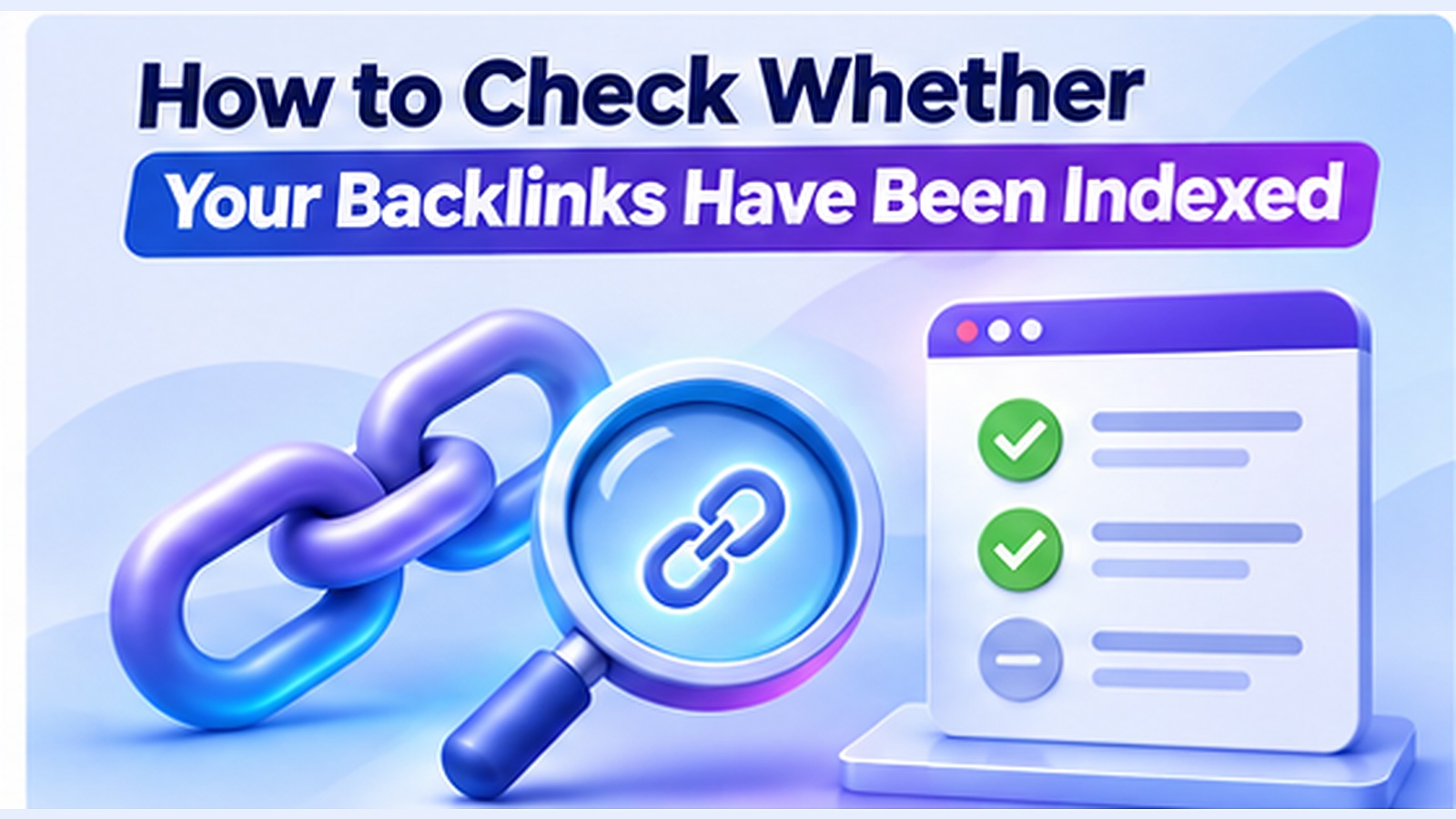
“Is my backlink indexed?” sounds like a simple yes-or-no question. In practice, you need to distinguish whether the webpage containing the backlink is indexed, whether the link itself exists and is crawlable, and whether a particular reporting tool has discovered it.
Google does not offer a public tool that reveals a definitive, complete list of backlinks Google has evaluated for ranking. What you can build is a defensible verification workflow with clear evidence levels.
Decide what you are measuring#
A useful campaign report should avoid one ambiguous indexed column. Track at least these fields:
| Measure | Question it answers | Evidence |
|---|---|---|
| Link live | Does the source page contain the expected hyperlink? | Fetched HTML / rendered DOM |
| Source accessible | Can a crawler retrieve the page? | HTTP response and directives |
| Source indexing | Is the source URL selected for Google's index? | Owner's URL Inspection report |
| Link reported | Does a tool include the backlink in its database? | Search Console / third-party report |
| Link quality | Is the placement useful and editorially relevant? | Human review |
The first field is usually straightforward. The third often requires cooperation from the publisher because Google Search Console inspects properties you are authorized to access.
Method 1: Verify the link on its source page#
Open the exact guest-post or source-page URL. Confirm the article loads and that the hyperlink points to the correct destination. For a reproducible check, inspect the rendered DOM or HTML:
<a href="https://yourbrand.example/guide/">Read the original guide</a>
If the live page uses a redirected destination, document the final landing URL. Also capture anchor text and any rel values, since a link may be present but have a different relationship than expected.
For a small set, manual inspection may be adequate. For a larger set, build a crawler that respects site access rules and rate limits. A command-line header request alone cannot confirm that a link is actually present in the page body.
Method 2: Ask the source-site owner to use URL Inspection#
For sites the publisher owns or manages, URL Inspection is the strongest practical source of Google-specific page indexing information. Ask the owner to inspect the exact source URL, not your target URL.
Check the indexing verdict, canonical selection, crawl timestamp, and applicable exclusions. If the source is a duplicate consolidated under another URL, inspect the canonical page and verify that it contains the link. A URL's live test only shows current fetchability; it is not proof the URL is already indexed.
Request indexing through Search Console is available only for URLs in a property the user owns or manages. A guest-post buyer cannot simply submit a third-party URL through their own Search Console account.
Method 3: Use Google searches as a clue—not a verdict#
You may try a quoted unique phrase from the source article, a search for the exact URL, or a site: query restricted to the publisher. These searches sometimes help you locate indexed documents.
However, search results are not an exhaustive index listing. Ranking, deduplication, query interpretation, and result presentation can make an indexed document hard to find. Do not mark “not indexed” solely because site:publisher.example/article returned no visible result.
Method 4: Interpret Search Console's Links report correctly#
Your own site's Search Console Links report is useful for learning about sampled external linking pages, major referring sites, anchor text, and linked target pages. It is not comprehensive. Google groups and normalizes some URLs and omits some links. The absence of one source URL therefore does not establish that Google never encountered it.
Compare report dates and export limits. Treat the report as one signal within a larger audit, not as a certification system.
Method 5: Compare independent backlink crawlers#
Commercial link indexes can help confirm that a third-party crawler has seen the source page. Their coverage and recrawl schedules differ, so disagreement is expected. If one tool reports a link and another does not, reopen the live source and evaluate whether it was recently changed, redirected, or canonicalized.
A third-party crawler seeing the link is useful evidence of reachability, but it cannot establish Google's internal evaluation of that link.
Method 6: Inspect technical risk factors#
For a source URL with uncertain indexing, evaluate:
- Status: Does it return
200for normal visitors and legitimate crawlers? Is it a soft 404? - Robots: Does robots.txt block crawling or does the page include
noindex? - Canonical: Is Google expected to select this URL or an alternate?
- Rendering: Is the link present in HTML or only after a user action?
- Discovery: Do the publisher's archive, categories, and related articles link to it?
- Content: Does the page have a real, distinct purpose beyond placing outbound links?
If these items need fixing, the publisher is generally the party who can make the technical changes.
Spreadsheet workflow for 100+ backlinks#
Create columns for campaign, source_url, target_url, anchor, link_live, first_seen, last_checked, http_status, canonical, index_evidence, evidence_date, next_action, and owner.
Use evidence values such as confirmed_by_owner_url_inspection, search_visibility_clue, unknown, and source_excluded, rather than forcing every row into yes/no. The model should preserve uncertainty where reliable evidence is unavailable.
Sample decision tree#
- Link missing? Contact the publisher and repair or replace the placement.
- Link present, page inaccessible? Fix the source site's access or server behavior.
- Link present, source owner confirms excluded? Diagnose the exact Page indexing reason.
- Source indexed, link absent in a report? Document the report's sampling limitations; do not assume the link is ignored.
- Everything technically fine? Focus on relevance, editorial quality, and campaign outcomes rather than resubmitting identical URLs repeatedly.
What to report to a client#
Use a concise evidence-focused statement such as: “The backlink is live on the publisher's canonical article. The publisher has confirmed the source page is indexed in URL Inspection as of November 10. The backlink is not currently shown in our sampled Search Console Links report; that omission is not conclusive.”
Avoid claims such as “100% of backlinks are recognized by Google” unless you have a valid definition, suitable methodology, and evidence to support it. Even an indexed source page does not disclose the ranking value of each outbound link.
Where CrawlMe fits#
Agencies can use CrawlMe for structured bulk URL submission campaigns and API-driven workflows. Store CrawlMe's submission outcome separately from link verification and Google's indexing evidence. An accepted or processed submission is not an index-status verification result.
Frequently asked questions#
Is checking whether a backlink is indexed the same as checking the referring page?#
Most practical checks focus on whether the referring page itself is indexed. Google does not provide a complete public per-link “indexed” flag.
Can I inspect a competitor's backlink source URL in Search Console?#
Only if you have authorized access to that source property's Search Console data. Public searches and third-party tools are less definitive.
How often should I recheck backlinks?#
Match your cadence to campaign value, link volatility, and recent fixes. A weekly or monthly review can be reasonable operationally; it is not a Google-prescribed indexing interval.
What if the source is indexed but my rankings don't improve?#
That is normal. Ranking depends on many factors, and an individual link is not guaranteed to produce a measurable uplift.
Bottom line: Use verifiable evidence, preserve unknown states, and keep source-page indexing, backlink presence, and reporting visibility separate.