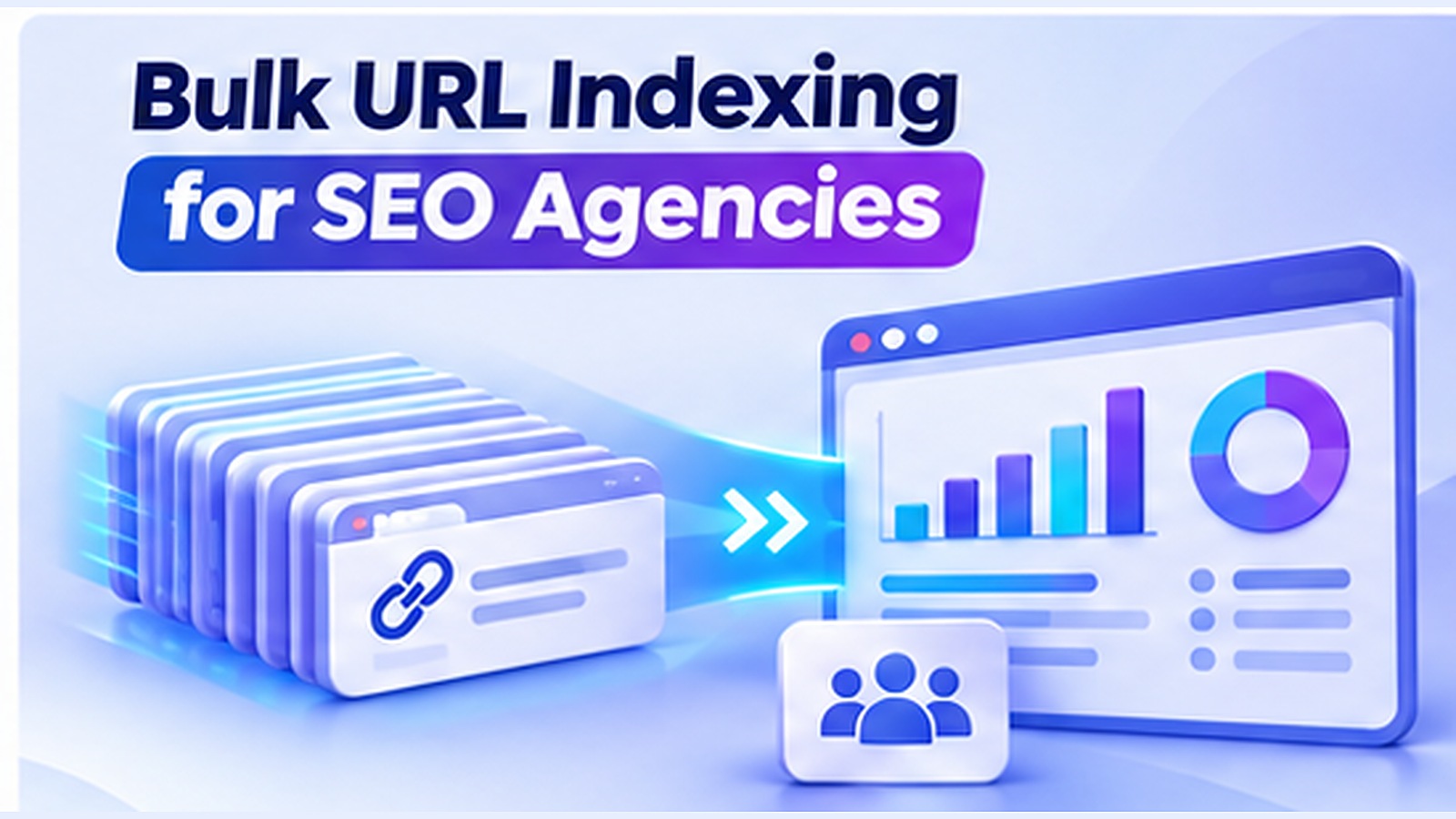
SEO agencies often manage more URLs than a person can sensibly copy into a form. A launch may include hundreds of product pages, a migration may generate a large list of changed addresses, and a link-building campaign may involve multiple publishers. Bulk URL indexing workflows can help manage those lists—but only when an agency distinguishes submission operations from Google indexing outcomes.
This playbook explains how to run repeatable, auditable campaigns without selling clients a false guarantee.
Start with the client's actual objective#
Ask what the campaign is intended to achieve. A new e-commerce catalog needs important product pages discoverable. A migration needs redirects, canonicals, and internal links corrected. A link-building campaign needs live, relevant publisher placements. Those are different jobs.
Segment work into owned-site URLs and third-party source URLs. For a site the client owns, you can verify Search Console, inspect pages, and repair technical barriers. For a third-party URL, you may only be able to verify public availability and request action from the publisher.
Do not pretend that one generic queue fixes both problems.
Phase 1: Collect and clean the URL inventory#
Create a file with one URL per row and mandatory fields: client_id, campaign_id, source_url, url_type, submission_priority, and reason.
Remove exact duplicates and normalize only when safe. Avoid blindly lowercasing paths, stripping query parameters, or removing trailing slashes because those changes can alter the resource. Preserve the original URL and a separate canonical/preferred URL where appropriate.
Reject invalid schemes such as javascript: and private hostnames that should never be submitted to external systems. Keep a separate exclusion list for login pages, checkout sessions, staging URLs, 404s, blocked pages, and obvious duplicate parameters.
Phase 2: Perform a preflight technical audit#
Owned pages should pass a basic quality gate:
- They return a useful, publicly accessible
200response or intentionally redirect to the correct destination. - Googlebot is not blocked by robots.txt, an unintended
noindex, an authentication gate, or a firewall rule. - The canonical target matches the page you want indexed.
- The page contains substantive content and can be rendered by Google.
- It is reachable through sensible internal links and, if appropriate, a sitemap.
For a backlink source page, check that it loads and actually contains the backlink. Do not demand owner-only Search Console evidence from a publisher unless they have agreed to provide it.
Preflight is often the highest-value part of the workflow. It prevents wasting credits and confusing flawed URLs with submission failures.
Phase 3: Design batches for accountability#
Use one batch per meaningful campaign or client segment rather than mixing every customer into an enormous queue. Name batches consistently, for example CLIENT-42_ProductLaunch_2026-11-10.
Record who submitted the list, when it was created, the initial URL count, duplicates removed, invalid entries, credits planned, and resulting processing status. A stable batch identifier makes troubleshooting and customer support easier.
A simple schema for your reporting spreadsheet:
| Field | Purpose |
|---|---|
| Campaign | Client and business objective |
| Batch ID | Traceable provider operation |
| URL count | Validated unique URLs |
| Submitted at | Timestamp with timezone |
| Processing status | Provider-side workflow state |
| Evidence status | Separate indexing/verification evidence |
| Cost | Credits or service spend |
| Next action | Fix, review, or follow up |
Phase 4: Choose official and third-party submission routes correctly#
For owned sites, use Search Console and XML sitemaps as the official baseline. URL Inspection handles a small number of specific URLs; sitemaps are suitable for large URL inventories. Google applies request quotas and explicitly states that repeat requests do not accelerate crawling.
Google's official Indexing API is limited to eligible job posting and livestream pages, not general article or backlink indexing. A vendor's API may be a legitimate interface to its own service, but that does not make it Google's restricted Indexing API.
A third-party submission platform can help centralize URL jobs, especially where the team needs automation, credit accounting, and status visibility. Assess its processing definitions and marketing claims before adopting it.
Phase 5: Automate cautiously#
An agency integration should be resilient rather than elaborate. Useful behaviors include:
- Submit batches with an API key stored server-side rather than in browser code.
- Use idempotency where available to prevent accidentally charging the same request twice.
- Retry temporary network failures with backoff, but never blindly resubmit after an ambiguous timeout without checking the original result.
- Store provider batch IDs and timestamps.
- Respect API rate limits and distinguish validation errors from temporary outages.
- Protect client separation so one account cannot view another client's URLs or credit activity.
Pseudo-workflow:
publish -> validate URLs -> remove duplicates ->
preflight -> create campaign batch -> submit once ->
record provider ID -> monitor processing -> audit evidence
Avoid building an expensive real-time monitoring system if a daily status check and downloadable CSV adequately serve the team's workflow.
Phase 6: Report in precise terms#
Clients need transparent numbers. Consider four independent metrics:
- Submitted URLs: Accepted into the agency's workflow.
- Processed URLs: Completed under the provider's defined processing rules.
- Verified source pages: Pages with appropriately documented Google index evidence, when available.
- Business outcomes: Organic landing-page impressions, clicks, or conversions that align with the client's goal.
Do not present “submission processed” as “Google indexed” in a chart. If verified indexing coverage is based on a sample, report the sample size and selection method. If a public search result check is used, label it as a visibility clue rather than definitive confirmation.
Phase 7: Audit exceptions rather than resubmitting everything#
Group exceptions by root cause: blocked, server_error, canonicalized, duplicate, thin_or_redundant, awaiting_crawl, unknown, and submission_failure. Each group needs a different next action.
A server error needs infrastructure attention. A canonical duplicate requires a URL strategy decision. A third-party article missing its backlink needs publisher outreach. A provider-side timeout needs a controlled retry. Treating every exception as a resubmission problem can waste resources without fixing anything.
Scenario: 2,000 URLs across four clients#
Imagine an agency collects 2,000 URLs. After validation, 140 are duplicates and 60 are intentionally nonindexable, leaving 1,800 eligible for the next review. A technical check finds 90 owned URLs with accidental noindex and 25 publisher URLs whose links are absent. Fix those issues first; then submit the remaining appropriate URLs through the chosen workflows.
These are illustrative numbers, not measured CrawlMe performance. Their purpose is to show how segmentation and early validation save work.
Where CrawlMe fits#
CrawlMe provides credit-based URL submission, bulk processing, and API options that can help agencies manage repeated campaigns. Use its batch records as operational evidence and combine them with your own preflight checks, Search Console data for authorized properties, and client-specific reports. Keep Google's final indexing decision separate from the service's job states.
Frequently asked questions#
Should an agency submit every new URL through a paid tool?#
Not necessarily. Strong internal linking and maintained sitemaps may be sufficient for many owned sites. Choose tools based on workflow overhead and demonstrated value.
Can agencies use Google's Indexing API for guest posts?#
Not as a general-purpose submission route. Google's API has narrow structured-data eligibility requirements.
How do we avoid duplicate credit usage?#
Deduplicate URLs before submission, preserve batch IDs, and use idempotency or a request ledger when supported by the provider.
What is the best KPI for bulk indexing?#
There is no single universal metric. Track clean submitted URLs and processing outcomes separately from verified index coverage and organic business outcomes.
Bottom line: The best agency workflow is repeatable, evidence-led, and clear about what each system can—and cannot—confirm.