Editorial disclosure: CrawlMe publishes this comparison and has a commercial interest in the result. This is a feature-and-pricing comparison, not an independently conducted indexing-performance test. Prices and terms were checked on November 12, 2026, and may change. Links to each vendor's published information appear below.
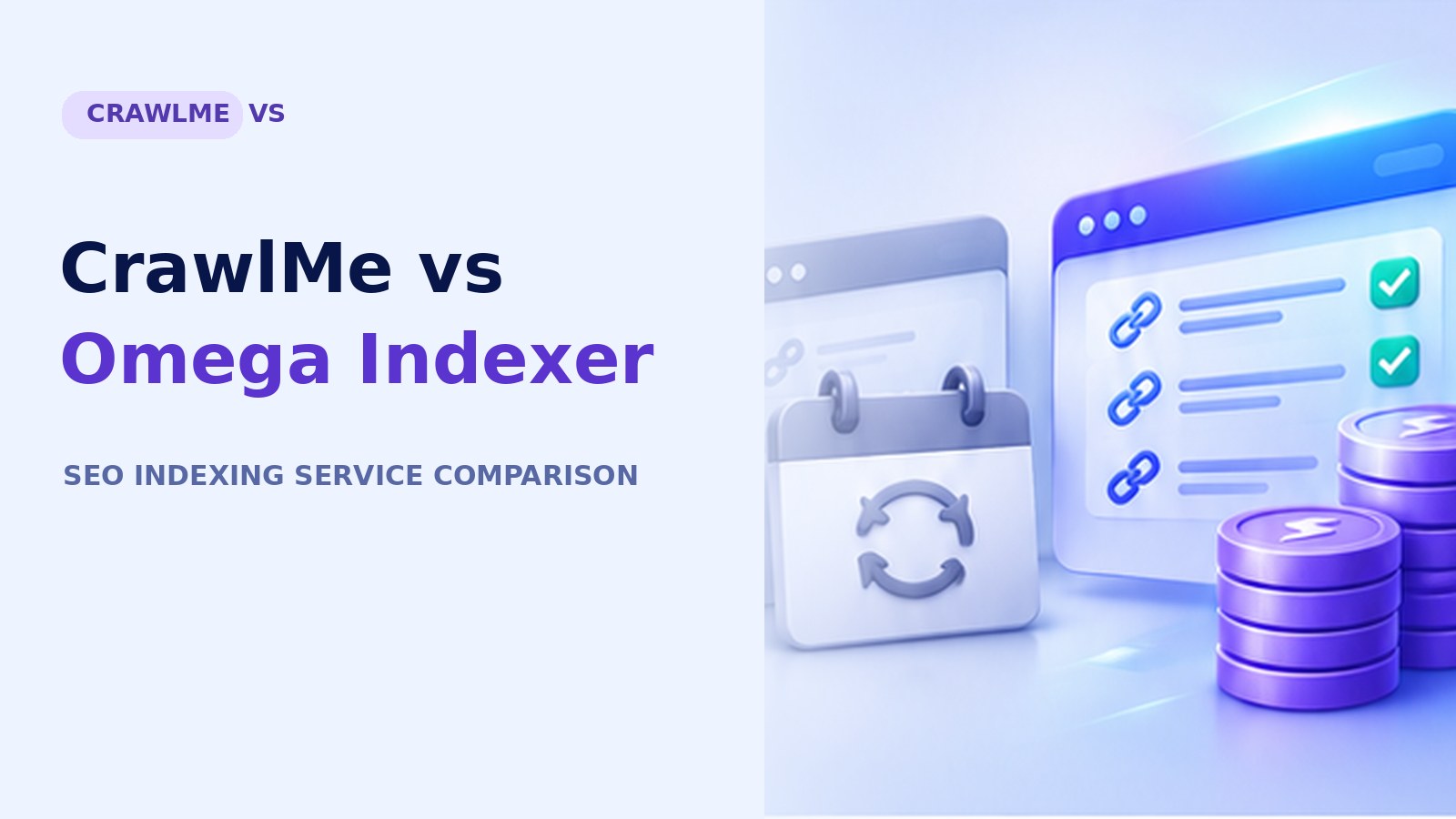
Choosing a URL indexing tool is not simply a matter of finding the lowest price displayed on a homepage. A team may be paying for a submission, a crawl attempt, a confirmed Googlebot visit, a result-based credit, a subscription quota, or an additional index check. Those are not interchangeable units. This guide compares CrawlMe with Omega Indexer in the context of occasional-use prepaid credits versus monthly plan and mcp automation.
The short answer#
CrawlMe is a compelling choice for teams that want inexpensive, non-expiring submission credits, a small minimum purchase and a straightforward bulk URL processing workflow. Omega Indexer can offer compelling advantages of its own. Omega markets automatic 24-hour credits-back terms, API integration, drip-feeding, and a hosted MCP server for AI-tool workflows. Neither service can force Google to include content in the index.
If you manage batches across different clients, this comparison provides a usable decision process, rather than a winner declared from vendor marketing statistics.
What CrawlMe and Omega Indexer actually sell#
CrawlMe advertises automated URL submission and processing for public URLs, including guest posts, backlinks, PDF links and other SEO-related pages. Its public prices are $0.40 for 25 credits; $16 for 1,000; $77 for 5,000; $145 for 10,000; $342 for 25,000; and $625 for 50,000. One credit represents a URL-processing submission, not a guaranteed indexed result. Published credits do not expire, and the product advertises API access. Read CrawlMe pricing before purchasing.
Omega Indexer uses a different or more specialized model. Omega Indexer lists $19 per month for 190 credits (about $0.10 each), with top-ups at $0.20 per credit. CrawlMe lists $16 for 1,000 non-expiring credits. Omega markets automatic 24-hour credits-back terms, API integration, drip-feeding, and a hosted MCP server for AI-tool workflows. Source: Omega Indexer official product/pricing information.
That distinction changes how to compare two screenshots of pricing. For example, a cost per submitted page cannot be fairly divided by another tool's cost per confirmed indexed page without knowing the outcome rate and how failed URLs are treated.
Comparison at a glance#
| Decision factor | CrawlMe | Omega Indexer |
|---|---|---|
| Main buying reason | Economical, non-expiring processing credits | Occasional-use prepaid credits versus monthly plan and MCP automation |
| Minimum public CrawlMe purchase | $0.40 / 25 credits | Check official competitor pack or plan |
| Billing model | Prepaid credits per processed URL | See published model in this article |
| Search-engine index inclusion | Not guaranteed | Not guaranteed |
| Evidence of indexing | Verify separately using appropriate index checks | Check whether included checks, reports or refunds apply |
| Who should investigate it | Agencies, freelancers, publishers handling varied URL batches | Buyers who specifically need the competitor's specialist features |
The cost comparison that matters#
One $16 CrawlMe Base pack buys 1,000 submissions and carries forward unused credits. Omega's $19 Starter plan buys 190 monthly credits, with top-ups priced separately; its plan and credit rollover terms should be checked before purchase.
Important: A monthly subscription is not necessarily wasteful for daily usage. Evaluate the whole three-month spend and the value of MCP, 24-hour refund terms and workflow controls.
A useful financial comparison tracks four separate numbers: (1) cash paid at checkout, (2) number of URLs sent into processing, (3) credits still available or returned under the vendor's rules, and (4) independently verified indexed URLs at a fixed follow-up date. If you publish only the first two, you may make the cheaper-looking service appear better even when the actual outcome cost differs.
A practical budgeting worksheet#
Suppose you have 1,000 candidate URLs. First, flag pages that are blocked by robots.txt, marked noindex, redirected, behind login, or substantially duplicated. This is not work an indexing vendor can reliably repair. Then identify the portion worth submitting and establish a baseline index status. Finally, compare vendor invoices with the actual number of newly indexed pages observed after an agreed window, such as 14 or 30 days.
For irregular workloads, CrawlMe's lack of an expiration date is valuable: unused processing credits remain in the account for later campaigns. For an outcome-refund product, returned credits can dramatically lower net acquisition cost for indexed pages. For a subscription product, its large daily capacity may be extremely economical when fully utilized. Each advantage has to be measured against real usage rather than treated as a universal ranking.
A realistic agency scenario#
Consider a freelance SEO who sends 400 URLs one month and none for the next two. The right approach is to decide what business outcome matters most. Is the team trying to keep submission overhead low? Does a client require proof that Googlebot visited every placement? Is final index status part of the client contract? Would a CMS plugin or integrated checker save staff time?
For routine submission work where the team already monitors index status in another system, CrawlMe offers a lean purchasing model. You can concentrate on cleaning the URL list, making one controlled submission, recording processing status and retaining credits for later work. It is especially useful when campaign volume is unpredictable.
By contrast, Choose Omega when MCP-driven submissions, campaign drip-feeding or its short credit-return window are central to daily work. This is not a disadvantage if those specialist features solve a real problem. An indexer that looks more expensive on a raw credit basis may be worth it when its reporting or credit-return mechanics reduce manual work or client disputes.
How to run a fair head-to-head test#
The only persuasive way to compare indexing performance is a controlled test on your own URLs. Avoid cherry-picking the easiest pages for one service and the most difficult for another.
- Create a representative URL inventory. Include similar proportions of guest posts, editorial backlinks, social pages and site-owned pages. Record HTTP status, canonical target, metadata, last modification date and baseline Google index status.
- Exclude obvious technical failures. A 404, inaccessible page or intentionally non-indexable URL should be counted separately, not used to inflate failure rates.
- Randomly assign eligible URLs. Use comparable groups for CrawlMe, Omega Indexer and an untreated control. Avoid submitting the same test URL to both tools during the main observation period.
- Document each submission. Record time, package, method, status and any credits returned. Do not mistake a provider's “success” processing status for an independently verified indexed result.
- Measure at predetermined intervals. Check at baseline, day 3, day 7, day 14 and day 30 when feasible. For properties you own, Google Search Console URL Inspection is more authoritative than broad search operators. For third-party URLs, independent checks are imperfect; note that limitation.
- Report uncertainty. Include how many URLs were tested, source quality, what verification method was used, and whether results persisted. A ten-URL test is useful for usability feedback but not a reliable performance benchmark.
Five checks before you pay#
- Model a slow month and a busy month separately
- Confirm current handling of credits after cancellation
- Test the MCP workflow if you already use AI coding tools
- Check when an indexed result is verified
What neither vendor can promise#
Google describes a process with discovery, crawling, indexing and serving. A page can be discovered but never crawled, crawled but excluded from the index, or indexed without ranking for a particular query. Search Console requests and sitemaps do not guarantee inclusion. The same limitation applies to third-party indexing tools.
Do not trust “100% indexing guaranteed” without reading what the guarantee actually covers. A guarantee to refund a credit, generate a crawl signal, deliver a crawler hit or process a queue is not a guarantee that Google will keep a URL in its index. Strong SEO fundamentals—public access, an indexable HTTP response, correct canonicalization, useful content and relevant internal links—matter regardless of vendor.
If a supposedly unindexed backlink appears in your link tracker, first distinguish the source URL (the page holding the backlink) from the target URL (the page receiving it). Verifying the target's index status does not tell you whether Google indexed the referring source page or evaluated the link. That distinction is essential to honest client reporting.
When CrawlMe is the better fit#
CrawlMe makes the most sense when you value transparent prepaid submission costs, flexibility for fluctuating volumes, and a minimal entry payment. It is particularly attractive for independent SEOs who do not need an expensive proof-of-crawl package on every low-value placement, or agencies already equipped with their own URL auditing and index-checking systems.
Its lower published entry price makes testing the interface less financially demanding. The API can also be considered by teams building internal automation, but confirm the endpoints, account permissions and rate limits against current documentation rather than assuming another platform's integration will work unchanged.
When Omega Indexer is a sensible choice#
Choose Omega when MCP-driven submissions, campaign drip-feeding or its short credit-return window are central to daily work. Omega markets automatic 24-hour credits-back terms, API integration, drip-feeding, and a hosted MCP server for AI-tool workflows. Paying more for a demonstrated feature is reasonable if the feature is in your service-level agreement or avoids measurable staff effort. Evaluate the feature in a pilot, not only through marketing descriptions.
Frequently asked questions#
Is CrawlMe cheaper than Omega Indexer?#
On the specific submission packages cited here, CrawlMe offers a low initial cost. However, Omega Indexer's charging unit, refunds, and bundled tools may change total value. Compare the same measurement and purchase size.
Does CrawlMe index more pages than Omega Indexer?#
There is no independent, controlled head-to-head indexing test presented here. Google decides whether a page is indexed; a submission, a crawler visit and a positive indexing check are different outcomes.
Can I use both Omega Indexer and CrawlMe?#
Yes. A disciplined experiment can allocate comparable URL groups across services, retain a no-service control group, and independently evaluate outcomes before committing budget.
Which tool should an SEO agency choose?#
For simple low-cost processing and irregular work, CrawlMe is attractive. For a specialist feature or refund term listed above, evaluate the competitor. Use your own URL cohort and reporting needs to decide.
Final verdict#
If the main goal is inexpensive, flexible URL submission processing, CrawlMe is the option we would shortlist first. It offers a very small entry purchase and clear, non-expiring credit packs. But if Omega Indexer's specialized checks, refunds, tracking or workflow integrations match your contract, the competitor may be worth its different pricing model. There is no justified basis here to claim CrawlMe indexes more URLs or indexes them faster.
You can review the current packages on CrawlMe and begin with a small, measurable pilot rather than committing a large campaign budget on promotional claims.
Related CrawlMe reading#
- Why is Google not indexing my website?
- How to get your website indexed by Google
- How to check whether your backlinks have been indexed
- Bulk URL indexing for SEO agencies
Sources and verification#
- Omega Indexer — official site / published information
- Google Search Central, How Search works
- Google Search Central, Google Search technical requirements
- Google Search Central, Ask Google to recrawl your URLs
- CrawlMe, Published pricing
- CrawlMe, Product overview and FAQ
Research checked November 12, 2026. Product features, pricing and eligibility may change; verify before publication. This comparison was not sponsored by Omega Indexer.