A site can load perfectly for a human and still fail for a search crawler. CDNs, security rules, login redirects and aggressive anti-bot challenges sometimes become the hidden cause of widespread discovery or indexing trouble.
This guide is designed as an operational reference. It separates what can be observed, what can be fixed on your website, and what Google ultimately decides independently. Examples use example.com and are illustrative, not claims about CrawlMe customers or experimental results.
Understand the underlying SEO problem#
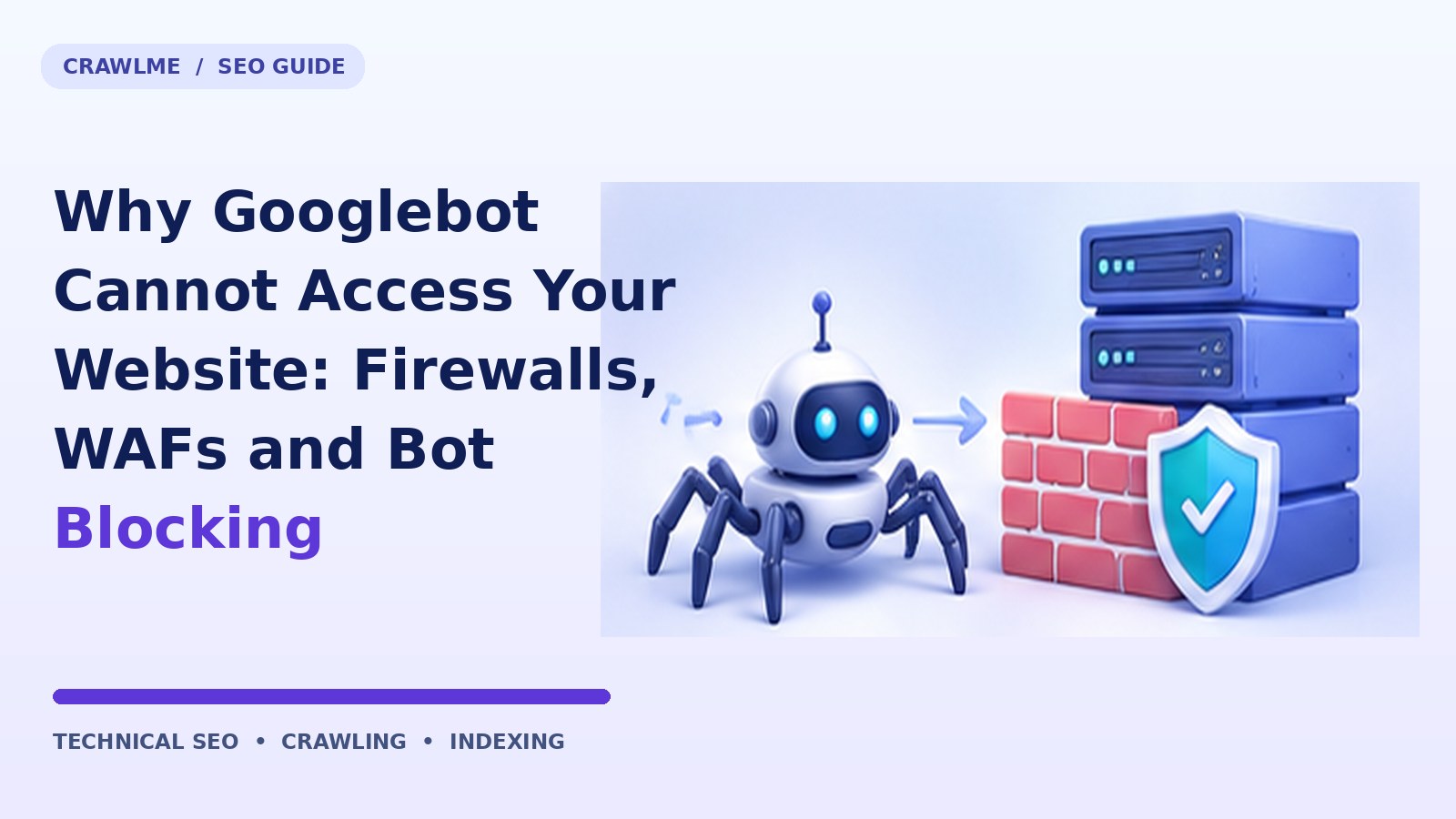
Start by distinguishing DNS and TLS failures, HTTP 403/429 responses, JavaScript challenges, robots.txt blocks and timeouts. Googlebot identification should be verified, not trusted solely because a User-Agent string says Googlebot. A firewall can deny HTML, JavaScript or image files independently, creating partial rendering failures.
The distinction matters because an apparent indexing failure can begin at several different layers: the page may be unavailable, a crawler may be unable to discover it, a canonical may point elsewhere, or Google may simply choose not to show the page for a query. Begin with evidence from the layer involved. Changing a title, adding a sitemap or submitting the same URL again cannot repair an unrelated server or policy error.
Before changing anything: establish a reliable baseline#
Compare URL Inspection live tests with server and CDN event logs at the same time. Group rejected requests by URI, rule ID, action, response code, IP and User-Agent. Check whether robots.txt and essential scripts are available. Validate suspicious Googlebot traffic using Google’s documented verification method before adding exceptions.
Record the original response and page content before edits. Save the URL, intended canonical, date, device or crawler profile, and observation source. If you cannot reproduce a problem under the same conditions, you cannot reliably claim the next change fixed it. Prioritize high-value canonical URLs rather than trying to repair every incidental variation immediately.
A concrete diagnostic check#
Inspect: CDN security event action + verified crawler IP + failed URI. This is a starting test, not a final verdict. Run it on several representative URLs, including one known healthy page, one affected page and one edge case. Compare the results. Where a test uses a command or URL pattern, substitute your own domain and check both returned headers and rendered content as appropriate.
A practical triage worksheet should include:
| Field | What to record |
|---|---|
| Intended URL | The public URL that should serve the content |
| Observed result | HTTP status, rendered behavior or report status |
| Expected result | The exact behavior the owner wants |
| Suspected layer | Server, crawler access, URL structure, content or search reporting |
| Evidence | Request trace, screenshot, export or log sample with date |
| Owner and follow-up | Person responsible, change deployed, retest date |
Fix the cause, not the symptom#
Scope exceptions narrowly: verified crawler traffic, required read-only resources and correctly rate-limited public paths. Remove captchas from public indexing paths if they block legitimate bots. Preserve login, checkout and admin protections. Add dashboards and a rollback plan for changed WAF rules.
Apply the smallest coherent change that resolves the observed defect. Check both a successful control URL and the affected URL after deployment; fixing one page template can accidentally alter others. If the solution changes URLs, redirects, canonical annotations or crawl permissions, update linked infrastructure and internal navigation in the same rollout.
A good release has three parts: a documented problem statement, a change that maps directly to that problem, and a verification step with a rollback option. In an agency, attach this evidence to the client ticket; in a product team, attach it to the deployment record. This keeps future investigations from repeating an already disproven hypothesis.
Worked example: what the right decision looks like#
A CDN rule challenges every unknown visitor on /articles/, but staff browsers pass due to cookies. Googlebot receives a challenge page. Changing article quality or resubmitting the URLs will not fix the access problem; the rule and its verification logic must be corrected.
Notice the decision sequence: first establish what the server or page actually does, then decide whether the URL belongs in the index, and only then make a change. The same symptom can occur for unrelated reasons across different sites, so copying a competitor's settings without understanding the cause is unreliable.
Common mistake to avoid#
Never whitelist an IP list copied from an old blog or disable the entire WAF to improve crawl coverage. Verify the requester and make exceptions least-privilege.
Additional failure mode: A valid Googlebot request can be blocked by a generic automated-traffic rule. If your proposed fix does not address that failure mode, pause and gather better evidence. For large sites, test against a sample of URLs from every affected template; a fix that works on a blog post may not work on product variants, paginated archives or translated pages.
How to verify the change worked#
Compare Googlebot-verified 403/429 counts, rendering-resource failure rates, successful crawl responses and Page indexing report trends after the security fix.
Use a two-stage validation process. Immediately after the deployment, test the actual server response, links, page markup and rendered output: these are within your control. Over subsequent Google crawling and reporting cycles, review Search Console and search visibility trends: those are external observations and may lag behind the technical fix. Avoid declaring success just because a request was submitted, a sitemap fetched, or an indexing queue completed.
Build a small before-and-after table with dates and metrics. If you changed multiple systems at once, annotate the deployment timeline so that changes in search traffic are not incorrectly attributed to a single setting. Use comparable date ranges and account for seasonality and fresh-content publication when evaluating outcomes.
A five-point handoff checklist#
- Document the exact affected URL group. Record why it matters to users and which canonical pages should be visible.
- Capture a reproducible technical observation. Save the relevant response, report, rendered HTML, or verified log entry.
- Make a targeted correction. Change the URL, template, server rule or editorial issue supported by the evidence.
- Retest live delivery. Confirm the page and any related assets are accessible, coherent and linked correctly.
- Review search outcomes separately. Revisit Google’s index or performance observations later without assuming a guaranteed timeline.
When CrawlMe fits the workflow#
After technical problems are resolved, SEO teams often need a repeatable way to organize large sets of publicly accessible URLs and manage submission batches. CrawlMe provides a credit-based URL submission workflow and API capabilities for that operational stage. It does not replace Google Search Console, sitemap hygiene, crawlable internal links, proper canonical signals or technical repair. A successful submission or processing status must never be described as confirmed inclusion in Google's index.
For this topic, the sensible order is: Test with a real verified requester and keep least-privilege exceptions. Only then decide whether bulk URL submission management is useful.
Frequently asked questions#
Will submitting the URL again guarantee Google indexing?#
No. Submission and processing are not Google's indexing decision. Fix the underlying access, discovery or content problem, and use relevant Google reports to evaluate outcomes.
How quickly should I expect a change in Search Console?#
There is no universal clock. Server and page-level changes can be tested immediately, whereas Google crawling, indexing and report updates happen on their own schedules. Monitor the affected pages over time instead of repeatedly forcing the same request.
Should I apply the same fix to every URL?#
Only when the same cause is confirmed. Template-wide changes are efficient if the defect is shared; sitewide changes based on one example can produce unintended canonical, redirect or crawling problems.
What should I prioritize if resources are limited?#
Start with pages that are intended to be indexed and important to users or business operations. Next address reproducible access and technical defects affecting whole groups. Low-value URL permutations usually require a different strategy from valuable canonical landing pages.
Further reading and primary documentation#
- Google Search Central documentation
- Google Search Central documentation
- Google Search Central documentation